
OUR BLOG
Valued discussions with our team from wherever you are in your day
FEATURED
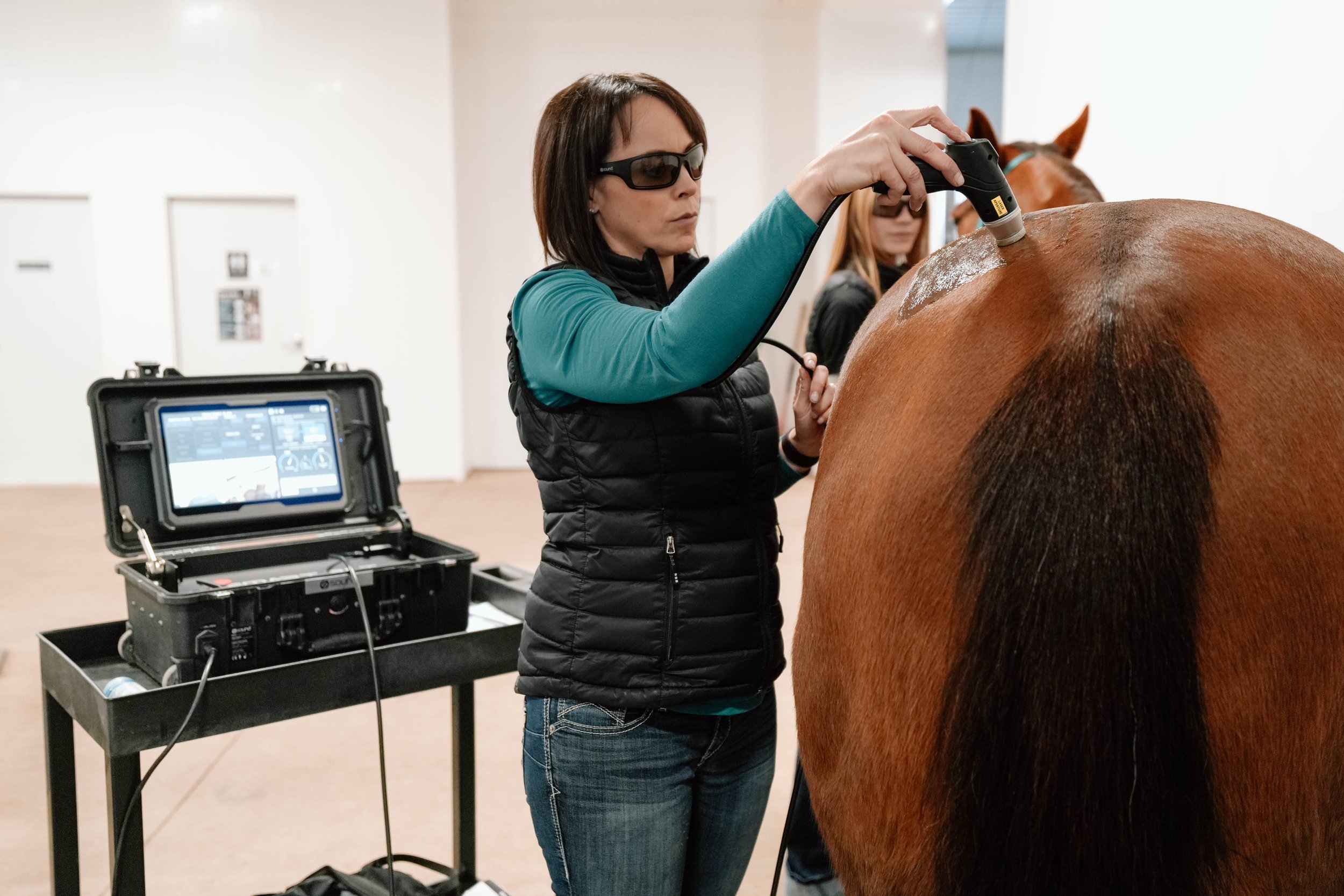
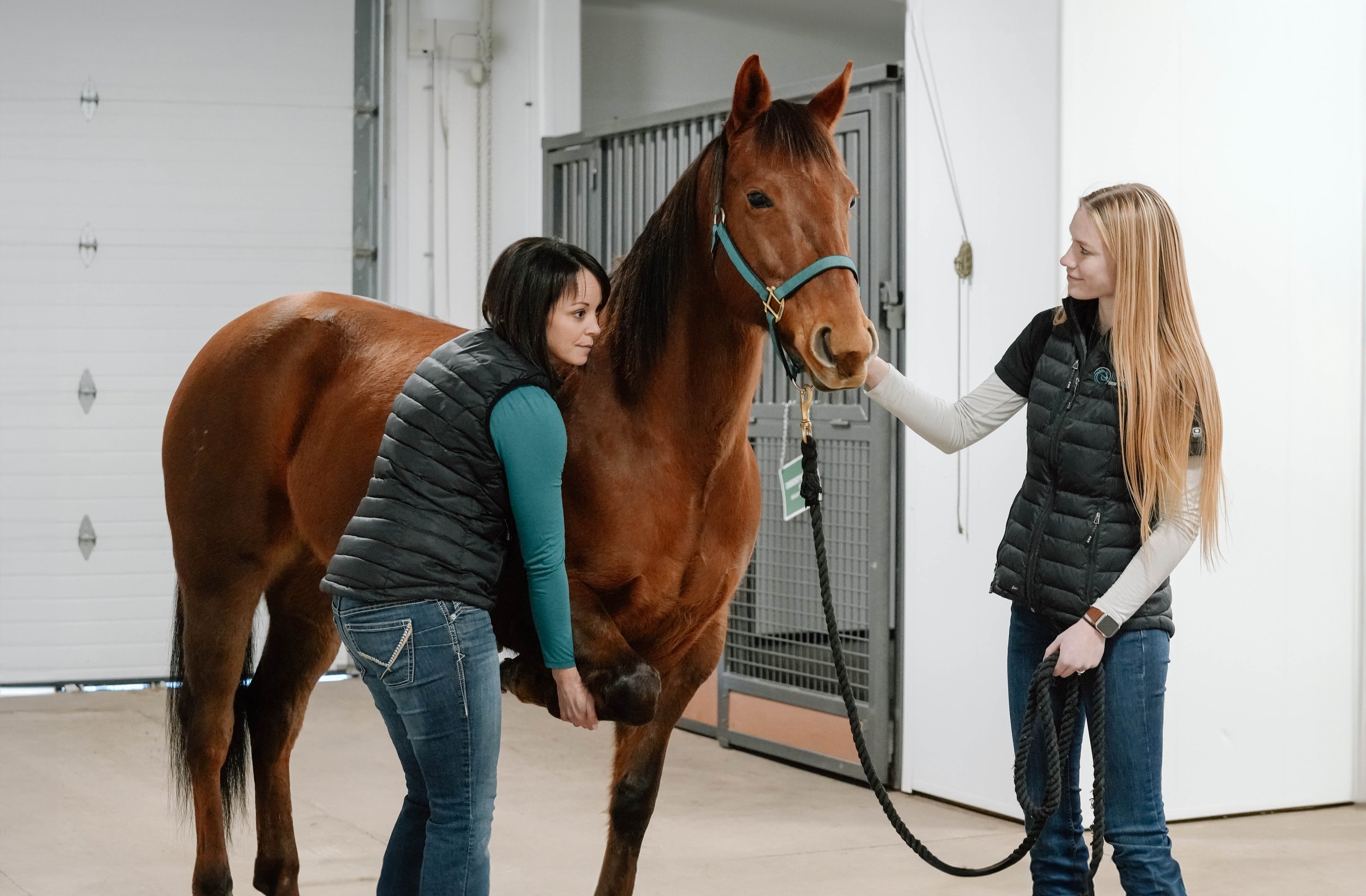
REGENERATIVE LASER THERAPY
Key Benefits of Regenerative Laser Therapy for Horses:
Accelerated Healing: The therapy stimulates cellular regeneration, accelerating the healing process for injuries and promoting overall tissue health.
Pain Management: By targeting inflamed areas and releasing endorphins, the therapy aids in pain management without the use of pharmaceuticals.
Improved Joint Function: Regenerative Laser Therapy has shown effectiveness in reducing inflammation in joints, contributing to enhanced mobility and flexibility.
Enhanced Performance: Many equestrians have reported improved performance levels in their horses after incorporating regenerative laser treatments into their care routines.
Non-Invasive and Stress-Free: Unlike some traditional treatments, this therapy is non-invasive, stress-free, and well-tolerated by horses, ensuring a positive experience for both the horses and their humans.

Focus on Lameness - Lameness Locator Demonstration
Dr. Crystal Lee performs a live demonstration of the Lameness Locator.

Focus on Lameness - The Lameness Locator
Dr. Crystal Lee discusses objective lameness evaluation using wireless inertial sensors.

Focus on Lameness - General Lameness Exam
Dr. Alyssa Butters discusses the typical progression of a lameness exam.
This excerpt is part 1 of 4

Sugar - Skin Grafting
Sugar sustained a major laceration to the front of her carpus during the big snowstorm we had in September 2014. Even though her owner found it the day it happened, there was already a large amount of swelling present as well as a large amount of dirt and contamination in the wound. Initial treatment included intravenous regional limb perfusions with antibiotics, intravenous antibiotics, and bandaging. Because of the large amount of motion present on the front of the carpus, we ultimately decided to use pinch grafts in this wound. Pinch grafts are small 3mm discs of skin, harvested by removing an elevated cone of skin, that are implanted into small slits in the granulation tissue.

Dan - Third Eyelid Removal
In horses, the third eyelid is prone to developing squamous cell carcinoma. Squamous cell carcinoma is the second most common tumour in horses, and it is the most common tumour in the equine eye. It develops most commonly on areas lacking pigmentation, poorly haired regions, and skin near mucocutaneous junctions. It can be quite an aggressive tumour, spreading to nearby tissues and local lymph nodes. In the third eyelid, it often initially appears as a reddened area, then becoming raised and in some cases developing a wart-like appearance. In most other areas, recurrence is extremely common unless surgical excision is combined with another treatment such as chemotherapy or cryotherapy. Fortunately, the third eyelid can be removed in its entirety, and a success rate of 90% has been reported with removal alone.
The Equine Eye by Dr. Kirby Penttila
Understand Your Horse’s Vision and Common Eye Disorders. Written for the Canadian Horse Journal’s July 2015 issue.

Vaccination FAQ - What are common side effects of vaccination? What can I expect after my horse is vaccinated?
Just as in humans, most vaccinations cause at most very mild outward symptoms after the vaccine is given. Some horses may be a little more lethargic than usual, have some mild tenderness at the injection site, or stiffness in the neck if that is where the vaccine was administered. Occasionally, the horse will develop a mild and transient fever, and this is usually noticed if the horse goes off his feed. These usually resolved uneventfully, although sometimes anti-inflammatories are given.

Why We Vaccinate - Equine Herpesvirus (“Rhinopneumonitis”)
With several recent outbreaks of neurological herpesvirus infections in the US and Canada, much attention has been turned to this common disease. The virus is not new, and is considered endemic in most regions of the world. Although some aspects of the disease have been understood for decades, there is still much to be learned about the virus and its effects on horses.

Vaccination FAQ - Why are horses vaccinated for tetanus yearly, whereas humans are boostered every 5-10 years?
Both horses and humans are very susceptible to tetanus, horses even more so than humans. In humans, there are many studies examining the duration of immunity following vaccination, so physicians can feel confident in their recommendations of extending the revaccination interval. In horses, a 6 month study comparing responses to commercial vaccines demonstrated significant antibody response for the duration of the study, but did not measure the response beyond 6 months. There have not been any studies in North America that have challenged vaccinated horses with tetanus toxoid, but antibodies alone can mediate protection. Conclusions about efficacy of the vaccine and duration of protection are based on antibody levels detected in laboratory studies combined with field experience, and the recommendation for yearly vaccination stems from this. There have been rare reports of horses with clinical cases of tetanus that had been vaccinated, however survival of horses with tetanus is strongly associated with previous vaccination.

Vaccination FAQ - Why is the Strangles vaccine intranasal? Isn’t there an intramuscular vaccine available?
The theory of an intranasal vaccine for Strangles is that the site of entry and infection with Strangles is via the tonsils located in the nose and mouth. If we stimulate immunity at these sites by introducing a vaccine directly to those tonsils, we can limit the propagation of the bacteria at its site of entry. The Strangles vaccine most commonly used is a modified live bacterial vaccine, which is unable to replicate but mimics the immunity stimulated by a natural infection. However, its efficacy is dependent on an adequate amount of the vaccine reaching the tonsils deep in the head, so it must be administered via the nasal passageways.

Rabies in Alberta—Should We Be Vaccinating Horses?
Alberta stands out as one of the few jurisdictions in North America in which horses are not routinely vaccinated against rabies. Arguments have always been that the incidence of rabies is much lower than in other regions, and there have been no reported equine cases of rabies in years, so the risk of infection would be so low as not to necessitate vaccination. The rabies vaccine must be administered by a veterinarian, another potential stumbling block to widespread vaccination of equines.
The rate of rabies in potential sources of infection within Alberta is the same whether we are considering a wildlife vector could infect a dog, a cat, or a horse. Yet rabies vaccination of our small animal companions is routine whereas vaccination of horses is almost non-existent. Although relatively rare, rabies is present in wildlife populations in Alberta, clinical disease should it occur is untreatable and (almost) invariably fatal, and a rabid companion animal or even horse can have very significant public health ramifications. Should we be revisiting this policy of non-vaccination of horses in Alberta?

Why We Vaccinate - Equine Influenza
Equine Influenza Virus (EIV) is often cited as the most commonly diagnosed and economically important causes of viral respiratory disease in horses. Therefore, the AAEP states that “all horses should be vaccinated against EIV unless they live in a closed and isolated facility.” Like many other respiratory viruses, it produces fever, nasal discharge, and coughing. So what sets this virus apart from other equine respiratory viruses?
TOPIC SUBMISSIONS
Want to learn more about a specific topic? Email your ideas to our team: office@burwashequine.ca
Archive
-
Breeding
- Mar 6, 2018 Placentitis - a reason for monitoring your pregnant mare
- Mar 6, 2017 Breeding Your Mare
- Mar 20, 2015 Breeding Your Mare: A behind-the-scenes look at the science of mare reproduction
- Nov 19, 2014 Fall Seminar 2014: An Introduction to the World of Reproduction
- Nov 10, 2014 Stallion Semen Freezing
- Oct 16, 2014 Pregnant Mare Management
- Apr 24, 2014 Breeding Your Mare
-
Dentistry
- Jan 25, 2020 EOTRH: a dental disease in the elderly equine
- Nov 25, 2019 Proactive Winter Horse/Donkey/Mule Care
- Jan 22, 2017 What happens to wild horses that don't get dental care?
- Apr 25, 2014 Equine Dentistry: Why Equine Veterinarians are Uniquely Qualified
- Apr 25, 2014 A Guide To Equine Dental Care
-
Deworming
- Nov 25, 2019 Proactive Winter Horse/Donkey/Mule Care
- Feb 13, 2015 Nasty Little Parasites - An Update on Deworming
- Oct 16, 2014 Parasite Control Recommendations
-
Emergencies
- Aug 29, 2024 Equine Emergencies
- Sep 1, 2021 Getting Back to Better by Dr. Crystal Lee
- May 8, 2016 First Aid Seminar - Part 2
- May 8, 2016 First Aid Seminar - Part 1
- Apr 15, 2016 First Aid Seminar Slides
- Oct 5, 2014 Brio - Heel Bulb Laceration
- Apr 27, 2014 Stone - Septic Tarsal Sheath
- Apr 27, 2014 Luke - Puncture Wound from a Nail in the Foot
- Apr 26, 2014 Roy - Carpal Laceration
- Apr 23, 2014 Be Prepared for an Equine Health Emergency
-
Foals
- Apr 17, 2020 Fall Seminar 2019 - The Events of Normal Foaling
- Mar 6, 2018 Placentitis - a reason for monitoring your pregnant mare
- May 24, 2016 My Newborn Foal
- Apr 16, 2016 When Foaling Is Imminent
- Apr 6, 2016 When is my mare going to foal?
-
Lameness
- Mar 14, 2023 Steve with no sole
- Nov 24, 2022 Regenerative Medicine and Orthobiologics
- Jun 1, 2022 Osteoarthritis by Dr. Katy White
- Jul 1, 2020 Recognizing and Managing the Club Foot in Horses
- Jul 1, 2018 Defying Age
- Jan 23, 2016 Fall Seminar 2015 - Update on the Lameness Locator
- Sep 13, 2015 Focus on Lameness - Imaging
- Sep 13, 2015 Focus on Lameness - Lameness Locator Demonstration
- Sep 13, 2015 Focus on Lameness - The Lameness Locator
- Sep 13, 2015 Focus on Lameness - General Lameness Exam
- Apr 11, 2015 Equine Lameness Evaluation
- Mar 25, 2015 Wireless inertial sensor based objective lameness evaluation - seminar slides
-
Medicine
- Dec 27, 2024 Why Your Horse Needs Vitamin E
- Aug 29, 2024 Equine Emergencies
- Nov 24, 2022 Regenerative Medicine and Orthobiologics
- Jun 1, 2022 Osteoarthritis by Dr. Katy White
- Feb 1, 2022 Respiratory Disease Round-Up
- Nov 13, 2019 Strangles
- Dec 20, 2018 Understanding PPID
- Jul 1, 2018 Defying Age
- Feb 1, 2016 Fall Seminar 2015 - Equine Infectious Anemia
- Sep 16, 2015 Flor - Pituitary Pars Intermedia Dysfunction (PPID)
- Nov 21, 2014 Fall Seminar 2014: Pigeon Fever Updates
- Nov 4, 2014 Fall Seminar 2014: Common Conditions of the Equine Eye
-
News
- Nov 24, 2022 Regenerative Medicine and Orthobiologics
-
Podiatry
- Mar 14, 2023 Steve with no sole
- Jul 1, 2020 Recognizing and Managing the Club Foot in Horses
- Nov 12, 2016 Fall Seminar 2016 - A Snapshot of the Horse's Foot - Equine Podiatry
-
Prepurchase Exams
- Nov 5, 2016 Fall Seminar 2016 - An Overview of Prepurchase Exams
- Apr 23, 2014 The pre-purchase exam: A wise investment
-
Surgery
- May 14, 2025 Nodin - Incisor Wiring
- Sep 1, 2021 Getting Back to Better by Dr. Crystal Lee
- Sep 26, 2018 Colic Surgery
- Oct 14, 2015 Misty - Enucleation surgery
- Sep 21, 2015 Junior - Sarcoid removal
- Sep 8, 2015 Sugar - Skin Grafting
- Aug 31, 2015 Dan - Third Eyelid Removal
-
Vaccines
- Nov 25, 2019 Proactive Winter Horse/Donkey/Mule Care
- Nov 13, 2019 Strangles
- Nov 5, 2016 Fall Seminar 2016 - An Update on West Nile Virus and Rabies in Alberta
- Feb 9, 2016 Fall Seminar 2015 - Vaccines
- Apr 30, 2015 Vaccination FAQ - What are common side effects of vaccination? What can I expect after my horse is vaccinated?
- Apr 28, 2015 Why We Vaccinate - Equine Herpesvirus (“Rhinopneumonitis”)
- Apr 24, 2015 Vaccination FAQ - Why are horses vaccinated for tetanus yearly, whereas humans are boostered every 5-10 years?
- Apr 23, 2015 Vaccination FAQ - Why is the Strangles vaccine intranasal? Isn’t there an intramuscular vaccine available?
- Apr 22, 2015 Rabies in Alberta—Should We Be Vaccinating Horses?
- Apr 21, 2015 Why We Vaccinate - Equine Influenza
- Apr 19, 2015 Vaccination FAQ - Potomac Horse Fever?
- Apr 18, 2015 Vaccination FAQ - Is it better to give multiple vaccines on one date, or split them into different visits?
- Apr 17, 2015 Vaccination FAQ - My horse needs his hocks injected, and while you are here, could we vaccinate him as well?
- Apr 16, 2015 Why We Vaccinate - Strangles
- Apr 14, 2015 Vaccination FAQ - Is it okay to ride my horse immediately before or after he or she is vaccinated?
- Apr 13, 2015 Why We Vaccinate - West Nile Virus
- Apr 12, 2015 Vaccination FAQ - Can I have my horse vaccinated if (s)he has a mild “cold?”
- Apr 11, 2015 Why We Vaccinate - Eastern & Western Equine Encephalitis (“Sleeping Sickness”)
- Apr 11, 2015 Vaccination FAQ - My horse is vaccinated—why did it still get a cold?
- Apr 9, 2015 Why We Vaccinate - Tetanus in Horses
- Apr 7, 2015 Vaccination FAQ - My horse doesn’t go anywhere—does (s)he still need to be vaccinated?
- Apr 6, 2015 What's in my vaccine?
- Apr 14, 2014 Vaccination Protocols
-
Wellness
- Jun 1, 2022 Osteoarthritis by Dr. Katy White
- Feb 1, 2022 Respiratory Disease Round-Up
- Jan 18, 2022 Baled It! with Dr. Lauren Friedl
- Sep 1, 2021 Getting Back to Better by Dr. Crystal Lee
- Nov 25, 2019 Proactive Winter Horse/Donkey/Mule Care
- Dec 20, 2018 Understanding PPID
- Jul 1, 2018 Defying Age
- Feb 14, 2018 Sorting Through Supplements - how to tell if the supplement is worth buying
- Jan 8, 2017 Fall Seminar 2016 - Senior Horses - A Focus on the Care and Quality of Life of Older Horses
- Dec 8, 2016 Saying Goodbye: a discussion about euthanasia
- Jul 1, 2015 The Equine Eye by Dr. Kirby Penttila
- Apr 11, 2015 Equine Lameness Evaluation
- Oct 16, 2014 Forage Alternatives