
OUR BLOG
Valued discussions with our team from wherever you are in your day
FEATURED
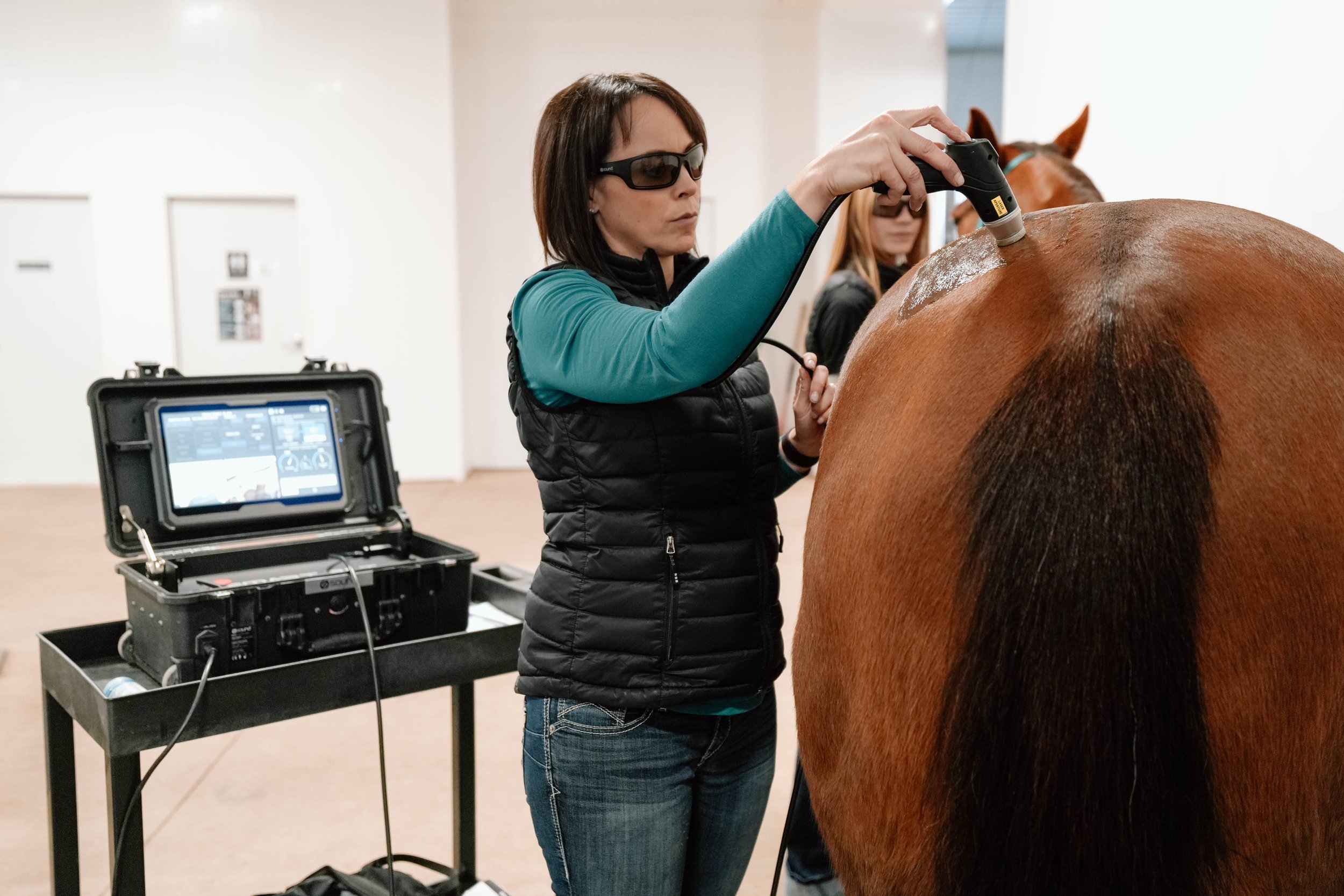
REGENERATIVE LASER THERAPY
Key Benefits of Regenerative Laser Therapy for Horses:
Accelerated Healing: The therapy stimulates cellular regeneration, accelerating the healing process for injuries and promoting overall tissue health.
Pain Management: By targeting inflamed areas and releasing endorphins, the therapy aids in pain management without the use of pharmaceuticals.
Improved Joint Function: Regenerative Laser Therapy has shown effectiveness in reducing inflammation in joints, contributing to enhanced mobility and flexibility.
Enhanced Performance: Many equestrians have reported improved performance levels in their horses after incorporating regenerative laser treatments into their care routines.
Non-Invasive and Stress-Free: Unlike some traditional treatments, this therapy is non-invasive, stress-free, and well-tolerated by horses, ensuring a positive experience for both the horses and their humans.

Why We Vaccinate - Equine Influenza
Equine Influenza Virus (EIV) is often cited as the most commonly diagnosed and economically important causes of viral respiratory disease in horses. Therefore, the AAEP states that “all horses should be vaccinated against EIV unless they live in a closed and isolated facility.” Like many other respiratory viruses, it produces fever, nasal discharge, and coughing. So what sets this virus apart from other equine respiratory viruses?

Why We Vaccinate - Eastern & Western Equine Encephalitis (“Sleeping Sickness”)
Eastern Equine Encephalitis (EEE) and Western Equine Encephalitis (WEE) are both neurological diseases spread to horses and humans from infected wild birds and rodents via blood sucking mosquitos. The disease typically culminates in a profound depression that characterizes these diseases in the late stages, and gives them the common name of “sleeping sickness.” The American Association of Equine Practitioners considers vaccines against EEE and WEE to be "core" vaccines, recommended for all adult horses.

Stallion Semen Freezing
We can start freezing a stallion’s semen as soon as he is sexually mature. For most horses this is any time after 4 years old, but some horses mature earlier or later than others. If your horse is not mature at the time of collection we will be able to see signs of immaturity when examining the sample under the microscope.
It is important to know that every stallion freezes differently, and freezes better in different agents. There are a variety to choose from, and so before performing a commercial freeze, a collection will be “test frozen” with a variety of different agents in order to determine the best agent for your stallion.

Parasite Control Recommendations
Parasite control needs to be tailored to your horse’s specific needs, taking into consideration age, immune status/individual susceptibility, time of year, and management practices. The following are basic recommendations that can be further tailored to suit your horse’s specific needs.
MATURE HORSES (>3 years old)
Small strongyles (cyathostomins) are the main parasite of mature horses, and these parasites are developing resistance to commonly used dewormers.
Horses vary in their susceptibility to small strongyles, and can be classified as Low, Medium, or High shedders based on fecal egg counts (FECs).
TOPIC SUBMISSIONS
Want to learn more about a specific topic? Email your ideas to our team: office@burwashequine.ca
Archive
-
Breeding
- Mar 6, 2018 Placentitis - a reason for monitoring your pregnant mare
- Mar 6, 2017 Breeding Your Mare
- Mar 20, 2015 Breeding Your Mare: A behind-the-scenes look at the science of mare reproduction
- Nov 19, 2014 Fall Seminar 2014: An Introduction to the World of Reproduction
- Nov 10, 2014 Stallion Semen Freezing
- Oct 16, 2014 Pregnant Mare Management
- Apr 24, 2014 Breeding Your Mare
-
Dentistry
- Jan 25, 2020 EOTRH: a dental disease in the elderly equine
- Nov 25, 2019 Proactive Winter Horse/Donkey/Mule Care
- Jan 22, 2017 What happens to wild horses that don't get dental care?
- Apr 25, 2014 Equine Dentistry: Why Equine Veterinarians are Uniquely Qualified
- Apr 25, 2014 A Guide To Equine Dental Care
-
Deworming
- Nov 25, 2019 Proactive Winter Horse/Donkey/Mule Care
- Feb 13, 2015 Nasty Little Parasites - An Update on Deworming
- Oct 16, 2014 Parasite Control Recommendations
-
Emergencies
- Aug 29, 2024 Equine Emergencies
- Sep 1, 2021 Getting Back to Better by Dr. Crystal Lee
- May 8, 2016 First Aid Seminar - Part 2
- May 8, 2016 First Aid Seminar - Part 1
- Apr 15, 2016 First Aid Seminar Slides
- Oct 5, 2014 Brio - Heel Bulb Laceration
- Apr 27, 2014 Stone - Septic Tarsal Sheath
- Apr 27, 2014 Luke - Puncture Wound from a Nail in the Foot
- Apr 26, 2014 Roy - Carpal Laceration
- Apr 23, 2014 Be Prepared for an Equine Health Emergency
-
Foals
- Apr 17, 2020 Fall Seminar 2019 - The Events of Normal Foaling
- Mar 6, 2018 Placentitis - a reason for monitoring your pregnant mare
- May 24, 2016 My Newborn Foal
- Apr 16, 2016 When Foaling Is Imminent
- Apr 6, 2016 When is my mare going to foal?
-
Lameness
- Mar 14, 2023 Steve with no sole
- Nov 24, 2022 Regenerative Medicine and Orthobiologics
- Jun 1, 2022 Osteoarthritis by Dr. Katy White
- Jul 1, 2020 Recognizing and Managing the Club Foot in Horses
- Jul 1, 2018 Defying Age
- Jan 23, 2016 Fall Seminar 2015 - Update on the Lameness Locator
- Sep 13, 2015 Focus on Lameness - Imaging
- Sep 13, 2015 Focus on Lameness - Lameness Locator Demonstration
- Sep 13, 2015 Focus on Lameness - The Lameness Locator
- Sep 13, 2015 Focus on Lameness - General Lameness Exam
- Apr 11, 2015 Equine Lameness Evaluation
- Mar 25, 2015 Wireless inertial sensor based objective lameness evaluation - seminar slides
-
Medicine
- Dec 27, 2024 Why Your Horse Needs Vitamin E
- Aug 29, 2024 Equine Emergencies
- Nov 24, 2022 Regenerative Medicine and Orthobiologics
- Jun 1, 2022 Osteoarthritis by Dr. Katy White
- Feb 1, 2022 Respiratory Disease Round-Up
- Nov 13, 2019 Strangles
- Dec 20, 2018 Understanding PPID
- Jul 1, 2018 Defying Age
- Feb 1, 2016 Fall Seminar 2015 - Equine Infectious Anemia
- Sep 16, 2015 Flor - Pituitary Pars Intermedia Dysfunction (PPID)
- Nov 21, 2014 Fall Seminar 2014: Pigeon Fever Updates
- Nov 4, 2014 Fall Seminar 2014: Common Conditions of the Equine Eye
-
News
- Nov 24, 2022 Regenerative Medicine and Orthobiologics
-
Podiatry
- Mar 14, 2023 Steve with no sole
- Jul 1, 2020 Recognizing and Managing the Club Foot in Horses
- Nov 12, 2016 Fall Seminar 2016 - A Snapshot of the Horse's Foot - Equine Podiatry
-
Prepurchase Exams
- Nov 5, 2016 Fall Seminar 2016 - An Overview of Prepurchase Exams
- Apr 23, 2014 The pre-purchase exam: A wise investment
-
Surgery
- May 14, 2025 Nodin - Incisor Wiring
- Sep 1, 2021 Getting Back to Better by Dr. Crystal Lee
- Sep 26, 2018 Colic Surgery
- Oct 14, 2015 Misty - Enucleation surgery
- Sep 21, 2015 Junior - Sarcoid removal
- Sep 8, 2015 Sugar - Skin Grafting
- Aug 31, 2015 Dan - Third Eyelid Removal
-
Vaccines
- Nov 25, 2019 Proactive Winter Horse/Donkey/Mule Care
- Nov 13, 2019 Strangles
- Nov 5, 2016 Fall Seminar 2016 - An Update on West Nile Virus and Rabies in Alberta
- Feb 9, 2016 Fall Seminar 2015 - Vaccines
- Apr 30, 2015 Vaccination FAQ - What are common side effects of vaccination? What can I expect after my horse is vaccinated?
- Apr 28, 2015 Why We Vaccinate - Equine Herpesvirus (“Rhinopneumonitis”)
- Apr 24, 2015 Vaccination FAQ - Why are horses vaccinated for tetanus yearly, whereas humans are boostered every 5-10 years?
- Apr 23, 2015 Vaccination FAQ - Why is the Strangles vaccine intranasal? Isn’t there an intramuscular vaccine available?
- Apr 22, 2015 Rabies in Alberta—Should We Be Vaccinating Horses?
- Apr 21, 2015 Why We Vaccinate - Equine Influenza
- Apr 19, 2015 Vaccination FAQ - Potomac Horse Fever?
- Apr 18, 2015 Vaccination FAQ - Is it better to give multiple vaccines on one date, or split them into different visits?
- Apr 17, 2015 Vaccination FAQ - My horse needs his hocks injected, and while you are here, could we vaccinate him as well?
- Apr 16, 2015 Why We Vaccinate - Strangles
- Apr 14, 2015 Vaccination FAQ - Is it okay to ride my horse immediately before or after he or she is vaccinated?
- Apr 13, 2015 Why We Vaccinate - West Nile Virus
- Apr 12, 2015 Vaccination FAQ - Can I have my horse vaccinated if (s)he has a mild “cold?”
- Apr 11, 2015 Why We Vaccinate - Eastern & Western Equine Encephalitis (“Sleeping Sickness”)
- Apr 11, 2015 Vaccination FAQ - My horse is vaccinated—why did it still get a cold?
- Apr 9, 2015 Why We Vaccinate - Tetanus in Horses
- Apr 7, 2015 Vaccination FAQ - My horse doesn’t go anywhere—does (s)he still need to be vaccinated?
- Apr 6, 2015 What's in my vaccine?
- Apr 14, 2014 Vaccination Protocols
-
Wellness
- Jun 1, 2022 Osteoarthritis by Dr. Katy White
- Feb 1, 2022 Respiratory Disease Round-Up
- Jan 18, 2022 Baled It! with Dr. Lauren Friedl
- Sep 1, 2021 Getting Back to Better by Dr. Crystal Lee
- Nov 25, 2019 Proactive Winter Horse/Donkey/Mule Care
- Dec 20, 2018 Understanding PPID
- Jul 1, 2018 Defying Age
- Feb 14, 2018 Sorting Through Supplements - how to tell if the supplement is worth buying
- Jan 8, 2017 Fall Seminar 2016 - Senior Horses - A Focus on the Care and Quality of Life of Older Horses
- Dec 8, 2016 Saying Goodbye: a discussion about euthanasia
- Jul 1, 2015 The Equine Eye by Dr. Kirby Penttila
- Apr 11, 2015 Equine Lameness Evaluation
- Oct 16, 2014 Forage Alternatives